What are you looking for?
 author
For PVC manufacturers, buying Dioctyl Sebacate (DOS) should involve more than comparing purity and price per ton. When a finished PVC product must remain flexible in cold environments, the key purchasing consideration is whether the supplier’s DOS provides consistent performance in the target PVC formulation.
A material may meet its raw-material specification but still fail to solve cracking, brittleness, migration, or long-term hardening in a finished PVC compound. For this reason, buyers should define the application first, review technical documents, run controlled formulation trials, and then evaluate batch consistency and supply capability.
At Yuanyide, we manufacture DOS together with DOA, DOTP, TOTM, DPHP and other plasticizers. We recommend qualifying a plasticizer according to the finished-product requirements rather than relying on price or one specification value alone.
DOS (Dioctyl Sebacate) is an aliphatic dibasic ester plasticizer widely used as a cold-resistant plasticizer for flexible PVC. Its primary formulation benefit is improving low-temperature flexibility by lowering the glass transition temperature (Tg) of the plasticized PVC system.
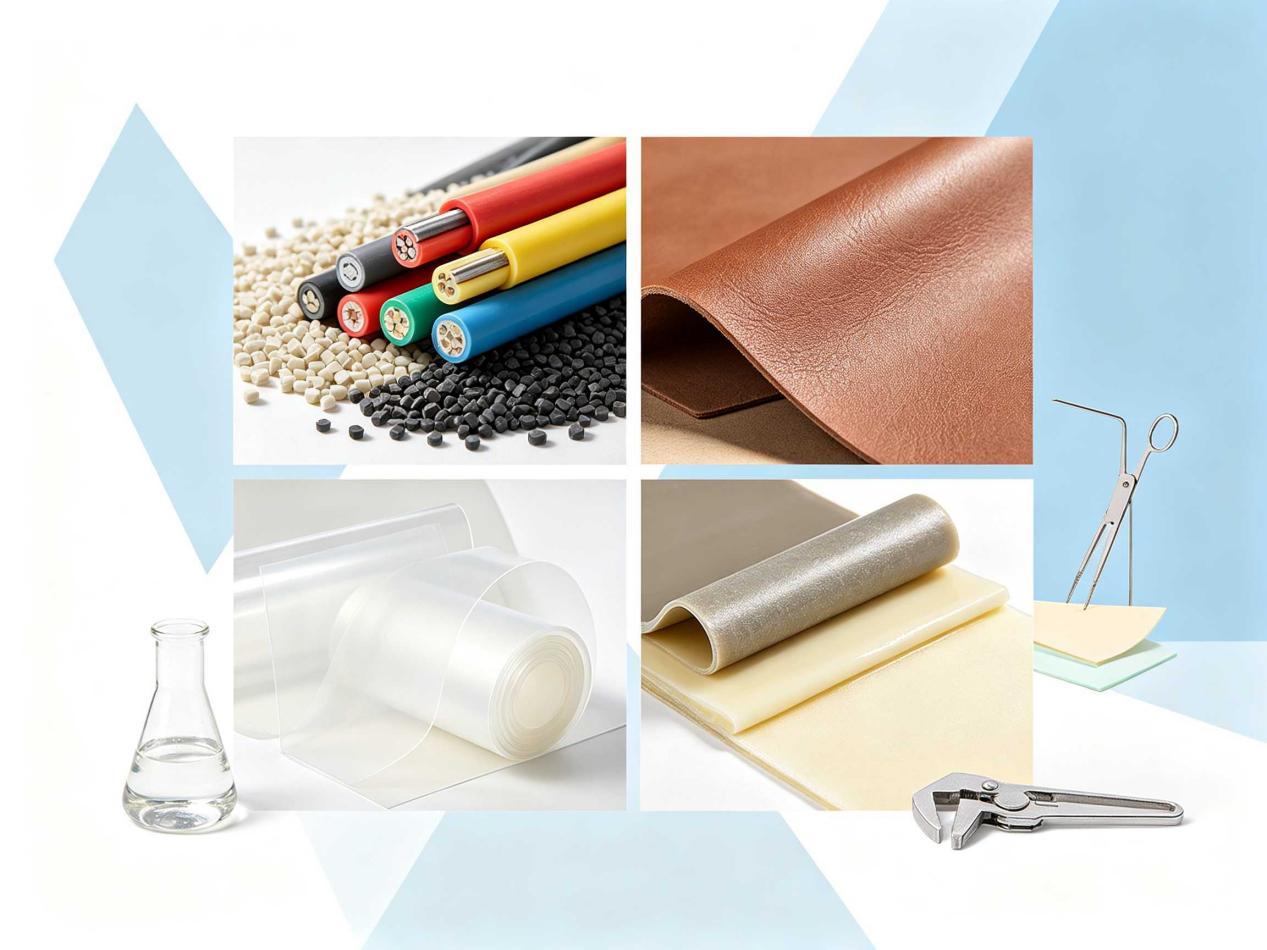
These characteristics make DOS relevant to applications such as cold-resistant flexible PVC wire and cable compounds, artificial leather, films, and adhesives. In practice, manufacturers may evaluate DOS when their current formulation becomes too stiff, cracks during cold bending, or loses flexibility after exposure to demanding service conditions.
However, the need for DOS should begin with a defined problem. If a PVC product fails at low temperature, plasticizer selection is only one possible factor. Resin grade, plasticizer loading, filler content, stabilizer system, processing conditions, and finished-product design can also affect the result.
Before asking suppliers for quotations, define exactly what the finished product must do.
A cable sheath exposed outdoors does not have the same performance requirements as a flexible film or artificial leather. Buyers should therefore record the final application, PVC resin grade, current plasticizer, total plasticizer loading, target hardness, stabilizer and filler system, processing conditions, and required minimum service temperature.
The temperature requirement also needs context. Specify the conditioning time, test method, and pass/fail criteria rather than simply asking, "How many degrees below zero can DOS withstand?"
A plasticizer alone does not determine the minimum service temperature of a finished PVC article. The complete formulation and finished product should be tested under conditions that represent the intended application.
Before comparing samples, buyers need a consistent raw-material baseline.
|
Specification |
Standard Limit |
|---|---|
|
Purity |
≥ 99% |
|
Color (Pt-Co) |
≤ 50#(Pt-Co) |
|
Density (20°C) |
0.913–0.917g/cm³ |
|
Acid Value (as KOH) |
≤ 0.1mg/g |
|
Moisture |
≤ 0.1% |
|
Flash Point |
≥ 210°C |
These parameters are useful for supplier qualification because they provide measurable limits for incoming material. They should not, however, be treated as proof that the finished PVC compound will automatically meet a specific cold-flexibility, migration, or aging requirement.
The purpose of a raw-material specification is to establish what the supplier must consistently deliver. Finished-product performance still requires formulation testing.
Confirm the destination market and end use. Review applicable chemical-supply obligations and any application-specific requirements before approving the grade. Raw-material documents do not replace finished-article compliance assessment.
The Technical Data Sheet should clearly identify key physical and chemical specifications, applicable test methods, packaging information, and typical applications. Buyers should compare the supplier’s published values with their own incoming-material requirements.
A Certificate of Analysis should provide actual test results for a specific production batch rather than simply repeating TDS limits.
Useful information includes the batch number, production date, specification limits, measured results, and traceability information. When qualifying a new supplier, comparing several batch COAs can help determine whether important parameters remain reasonably consistent.
The Safety Data Sheet supports decisions about storage, handling, personal protection, transportation, and emergency procedures. It serves a different purpose from the COA and should not be used as a substitute for batch-quality data. Confirm that the SDS matches the offered DOS product, manufacturer, chemical identity and destination-market requirements.
The candidate DOS should be evaluated in the target PVC formulation under controlled processing and testing conditions.
Create a controlled trial using the existing formulation as the reference. Keep the PVC resin, stabilizer, filler, lubricant, processing equipment, and major processing conditions unchanged wherever possible. Then replace or introduce the candidate DOS according to the planned formulation.
Record the DOS dosage in phr, total plasticizer loading, target hardness, processing temperature, conditioning temperature and time, test method, and acceptance limit.
This approach helps distinguish the effect of the candidate plasticizer from changes caused by other formulation variables.
At Yuanyide, we generally provide 100 mL or 200 mL samples for quality evaluation, with sample shipping costs borne by the customer. Buyers can use these samples for laboratory or pilot-scale formulation trials before confirming bulk procurement.
Low-temperature flexibility is important, but it should not be the only test used to approve a DOS supplier.
|
Performance Check |
What It Helps Verify |
|---|---|
|
Low-temperature flexibility |
Whether the compound remains flexible after cold conditioning |
|
Cold brittleness |
Whether bending or impact causes cracking or fracture |
|
Volatility |
Whether plasticizer loss may contribute to later hardening |
|
Migration |
Whether plasticizer moves to surfaces or contacting materials |
|
Heat aging |
Whether performance changes after thermal exposure |
|
Hardness retention |
Whether the compound becomes significantly harder after aging |
The exact test sequence should follow the finished product and customer requirements. For example, cable compounds may place greater emphasis on low-temperature flexibility and electrical performance, while artificial leather may also require close attention to surface condition, migration, and retained hand feel.
The important distinction is between initial softness and long-term performance. A PVC compound that is flexible immediately after production may behave differently after cold conditioning or aging.
Once a formulation passes technical testing, the supplier must demonstrate that the same quality can be supported during regular production.
Buyers should review several COAs where available and pay attention to variation in purity, acid value, moisture, density, and color. Batch traceability, specification-change communication, complaint handling, and procedures for non-conforming material should also form part of supplier approval.
Supply capability matters as well. At Yuanyide, we operate six plasticizer production lines, two workshops, and two warehouses, with an annual comprehensive production capacity of 50,000 tons. Our product portfolio includes DOS, DOA, DOTP, TOTM, DPHP and other plasticizers, allowing us to support customers who need to compare different performance directions.
Packaging and logistics should also match purchasing volume and storage arrangements. DOS can be supplied in IBC tanks, steel drums, and Flexitank packaging.
Before approving a DOS supplier, PVC manufacturers can use the following checklist:
|
Evaluation Area |
What to Verify |
|---|---|
|
Application |
What finished PVC product will use DOS? |
|
Service condition |
What is the minimum required temperature? |
|
Failure mode |
Hardening, cracking, brittleness, or another problem? |
|
Specification |
Are clear raw-material limits available? |
|
Documentation |
Are TDS, batch COA, and SDS available? |
|
Formulation trial |
Has the sample been tested in the actual PVC system? |
|
Cold performance |
Does the compound pass the agreed low-temperature test? |
|
Long-term performance |
Are volatility, migration, and aging acceptable? |
|
Consistency |
Are different production batches adequately controlled? |
|
Traceability |
Can supplied material be traced by batch? |
|
Supply |
Can capacity, lead time, and logistics support regular orders? |
|
Technical support |
Can trial results and formulation requirements be discussed? |
The cheapest DOS quotation does not necessarily produce the lowest manufacturing cost.
Procurement teams should consider material price together with formulation adjustment, repeated trial costs, rejected production, batch variation, customer complaints, logistics, and supply interruption risks.
Total procurement cost should include material price, formulation adjustment, qualification testing, production losses, batch-to-batch variation, logistics, and potential quality-related costs.
For PVC manufacturers, a more meaningful comparison is therefore not simply cost per ton of DOS, but cost per consistently qualified finished product.
When contacting Yuanyide, buyers can provide the PVC application, resin grade, existing plasticizer system, dosage in phr, target hardness, minimum service temperature, current failure mode, test method, migration or aging requirements, and estimated purchasing volume.
Based on this information, we can provide available product documents and a DOS sample for formulation evaluation. After laboratory or pilot testing, customers can share their results with us before moving to quotation and supply discussions.
Buying DOS for low-temperature PVC applications should be a qualification process rather than a price comparison. Start with the application and minimum service temperature, establish the raw-material baseline, review TDS, COA, and SDS documents, and then validate the sample in the actual PVC formulation.
After technical performance is confirmed, evaluate batch consistency, traceability, production capability, logistics, and technical support. This approach helps manufacturers select a DOS supplier based on repeatable production value instead of a low quotation alone.
Contact Yuanyide with your PVC product type, resin grade, current plasticizer system, target hardness, minimum service temperature, and testing requirements. We can provide available technical documents, sample support, and product recommendations to help you evaluate DOS and other suitable plasticizers before moving to bulk procurement.
A: Buyers should compare the DOS specification, TDS, batch-specific COA, SDS, sample performance in the existing formulation, low-temperature behavior, migration, volatility, aging performance, batch consistency, and supply capability.
A: Depending on the application, buyers can evaluate low-temperature flexibility, brittleness or cracking, volatility, migration, heat aging, hardness retention, and relevant electrical or mechanical properties.
A: Yes, when several performance requirements must be balanced. Yuanyide also manufactures DOA, DOTP, TOTM, and DPHP. Candidate materials should be compared under the same formulation and test conditions rather than selected only by plasticizer type.

The company adheres to the core concept of "customer-oriented, quality-oriented, excellence-oriented, and innovation-oriented", provides the market with cost-effective high-quality products with full passion, and promises first-class corporate services with honest faith. Continuously innovate and strive to become a permanent partner of customers.